How Low Can You Go?

I knew she’d listen to every note I played.  I wished the professor had suggested she sit somewhere else.  Somewhere she’d hear other musicians and their mistakes.

Instead of mine.

The young high school junior was visiting her university-going sister on campus.  No doubt, it was an exciting time for her.  I still remember that age.

Wide-eyed and inexperienced, the world held exhilaration at every turn.  College years would be a chance to be out on your own—away from the careful direction of overprotective parents.  A campus visit ahead of time offered a stimulating preview of the freedom that was to come.

Her sister is a member of the little chamber orchestra they are kind enough to allow me to participate in at the small liberal arts university.  Since the visiting young lady is also a French horn player, the professor thought it would be nice for her to sit in the horn section.

On my right.  Where the bell of my horn points.

I just knew she would hear every mistake and bobble proceeding out of the wayward instrument.

Well.  There was nothing for it but to get through the hour.  I started my warm-up.

I like to start with long tones—mid-range notes lasting several seconds each, descending down a scale before coming back up to finish on the original note.  After a few moments of that, I play some arpeggios—open chords—mostly descending until I reach a point at least two octaves below the starting midrange note.

The low pitch I end on is quite low, somewhere in the vicinity of what a tuba player would call mid-range.  Since my warm-ups always include that note and those leading down to it in the scale, I like to think I have developed a rather nice tone in that range, a range most horn players never attempt.

I end my warm-up by playing the arpeggios on up to the original mid-range and then up another octave before sliding back down to finish on the original note with which I began.

I saw her turn her head to look at me as I finished my warm-up.  I thought perhaps she wanted to say something, but the professor was already talking, introducing the young lady to the whole group.

It wasn’t a relaxing rehearsal.  We played a piece I only remember reading once before, so many of the passages were unfamiliar.  I stumbled and muffed more notes than I care to count, acutely aware of the girl’s presence beside me through all of them.

She heard every note.  Every one.

At the end of the rehearsal, I said a few polite words to her.  I hoped her visit would be all she was hoping for.  She was also polite.  We talked for a few seconds and she asked one question.

“What kind of range do you have?”

Immediately, I jumped to the obvious conclusion.  I supposed she meant: how high can you play?

I jokingly mentioned the highest note I’m comfortable playing is a high G, but pointed to the young lady on the other side of me, suggesting that she was the one who played the high C’s when necessary.

The girl wasn’t quite satisfied, starting another question.  

“But, what’s the low. . .” 

Before she could complete the question, her sister called her over to discuss what was next in their day’s schedule.  She never got a chance to ask what was on her mind.

I went on about my day, not thinking again about the girl’s curiosity.

I’m thinking about it now.

She wanted to know about my low range, not my high range.  She had heard my warm-up and knowing that most horn players avoid those low registers, wondered about how low I could go.

I’m wondering the same thing tonight.

Do you know I don’t have a very good high range when I play my horn?  Most players with similar experience to mine are quite adept at playing the highest notes on the horn.  Even many young players have a high range much superior to mine.

I wish it weren’t so. 

I want to play the high notes.  But, I can’t.

I’ve been thinking about this for a while now.

Why can I play the low notes (the ones most horn players eschew) with ease, but I can’t reach the high pitches?  What’s the problem?

As Mr. Tolkien puts it in his description of the scatter-brained innkeeper in his famous tale, even though he thinks less than he talks, and slower; yet he can see through a brick wall in time. . . 

I’m somewhat the same, thinking less than I talk (at times), but I believe I can see the answer to my problem.

You’ve probably already arrived at the solution, especially since it’s been explained at length up above. 

I’m good at the low notes because those are what I concentrate on every time—every single time—I pick up my horn to play.  My warm-up is a regimen I perform—without fail—before I look at a piece of music, before the conductor raises the baton for the first time, before even the first tuning note is sounded to be sure all the instruments are capable of playing the same pitch together.

I play low notes.  Every time, I play low notes.

I’m good at low notes.  Really.

But, I want to play high notes.

And, the Apostle said, the thing I want to do, I don’t do.  But, the thing I don’t want to do, that’s the very thing I do. (Romans 7:19

Of course, he’s talking about more important things than playing a horn, but then again, so am I. 

The thing I practice is the thing I will perform. Share on X

The thing I practice is the thing I will perform.  It is true in all walks of life.

If I practice complaining, one would never anticipate that I would rest patiently and with confidence.

If I practice arrogance and pride, I will never perform with humility.

If I live continually in defeat and expectation of loss, I can have no expectation of joy or fulfillment.

When the time comes to play the brilliant high notes in a concert performance, if I have resigned myself to practicing only the low and middle registers during every rehearsal, I will never—ever—shape my lips to sound the right notes.

I read today the words of a friend who is, by all earthly wisdom, fighting a losing battle.  His battle is for his life.  I was shocked to read of his laughter and joy as he fights the battle.

But tonight, I understand.  He is practicing for the performance still to come.   In anticipation of what he calls a joyful death, he’s decided to practice joy now—today, and for the rest of his days, however many he has.  

I’ve been working on the low stuff for too long now.  I’ve gotten much too accomplished at it.

I want to play the high notes.  I want the folks who are doomed to sit and listen to me to hear the good stuff.

It’s time for a new warm-up routine.

Today’s as good a time to start as any.


For the things we have to learn before we can do them, we learn by doing them.
(Aristotle ~ Ancient Greek philosopher ~ 384 BC-322 BC)


Keep putting into practice all you learned and received from me—everything you heard from me and saw me doing. Then the God of peace will be with you.
(Philippians 4:9 ~ NLTHoly Bible, New Living Translation, copyright © 1996, 2004, 2007, 2013, 2015 by Tyndale House Foundation. Used by permission of Tyndale House Publishers Inc., Carol Stream, Illinois 60188. All rights reserved.)


© Paul Phillips. He’s Taken Leave. 2018. All Rights Reserved.

Standing at the Gate

He did it with a smile on his face.  I saw it happen.

We were waiting for the nice lady at the bank to make a copy for us.  I can’t help it; I watch people.  So, while we waited, I watched.

I watched him lock himself and his dad in the vault.

Just to be clear, it wasn’t the big door—you know, the thick slab made of concrete-filled steel and secured with a time-lock.  This was what they call the day gate—a lighter affair, made with open metal rails that can be seen through.

Even so, I watched the little guy, all of three or four years old, swing the barrier back and forth a time or two.  It moved smoothly and noiselessly, so his dad, engrossed in his own activity inside, had no idea of what was happening.

The lad swung it and let go, reaching quickly to hold it and flip it back.  Looking up at me, he smiled.  There was no forethought or malicious intent in his face, simply the joy of being a child and a moment to entertain himself.

He swung it again, reaching for the edge, but missing.  I held my breath, hoping he’d catch it before it reached the end of its arc.  He didn’t.

Click!

The little fellow gave a tug at the door, but it stayed put.  He didn’t.  With one last sheepish grin, and an almost pleading look at me, he turned and dashed back into the room where his dad was still taking care of the task he had come to do.

The nice lady came back to our table and my attention was diverted from the scenario in the vault.  Even so, as she talked, it nagged at my consciousness.

I never heard a sound.  Still, moments later, I knew something was amiss.  I turned around and, there at the metal gate, saw the boy and his father standing.  This time, the pleading eyes were in the father’s face.  He didn’t say a word, but shrugged his shoulders and grinned—that same sheepish grin I had seen on the boy’s face earlier.

I suggested to the nice lady that she might want to let them out of the vault and she gasped, rushing to get the key and open the gate.

Not a single word passed between the man and me.  He needed help. I did what was in my power.  It wasn’t much.

Still, I haven’t been able to get the picture out of my mind.  The man, standing behind the gate, waiting for freedom.  In my memory, I see nothing but bars—that, and his face behind those bars.

Almost. . .Well—almost as if he were in prison.

I know it’s a stretch, but I can’t help but wonder if there are bars that lock me in, again and again.  Then again, what if the bars actually lock me out, too?

Prison isn’t only being locked in and held against my will.  Sometimes, prison is a place of my own making—the freedom of going where I want and doing what I have chosen.

Bondage can look a lot like freedom to us, if we’re not careful.  The little boy swinging the gate in fun found that out.

I’ve locked myself in more times than I care to count.

Just tonight, I read an email and slid home the bolt on the prison of fear.  Tomorrow may bring an unhappy encounter, so I  entered the cell tonight willingly, muttering to myself as I pulled the gate shut behind me.

The fear of what tomorrow may bring is a barren cell, fraught with pain and distress.  And yet, I may lie sleepless in this dreadful place the entire night.

A conversation with someone earlier today brought about the opportunity of making personal comparisons.  Without a thought, I acknowledged my superiority and in doing so, firmly latched myself into the prison of pride and arrogance.

The incarceration of the prideful may seem to be, at worst, a low-security lock-up.  But, like most hardened criminals, we return again and again, never reformed, to hear the gate click behind us as we fall into the habit of a lifetime.

There are so many prison doors.  Greed.  Gluttony.  Bigotry.  Selfishness.  Lust.  The list stretches as far as the cells in the cell block above.

Sometimes, it seems that others close the doors for us, just like the little boy in the bank.  It matters not.  The lock snaps closed and we are trapped once more.

I’ve spent enough time locked in those cells.  Maybe that’s true for more than just me.

I remember that there is One who holds the key to every door.  Every single one.

Isaiah, the one who seemed to see Him clearly through all the centuries that lay between, said the words first.  He has sent me to proclaim liberty to the prisoner—to open the locked gates behind which they await freedom.  (Isaiah 61:1)

Jesus used the same words to describe Himself.

He is the Key Holder—the Opener of Doors.

He is the Key Holder—the Opener of Doors. Share on X 

Locks, prison doors, barred gates—they mean nothing to Him.

I’m ready for better things.  Easier than the lady at the bank opening that gate, the prison doors will swing wide.

Time to walk free.

Free.


What a fool am I, thus to lie in a stinking dungeon, when I may as well walk at liberty? I have a key in my bosom called Promise that will (I am persuaded) open any lock in Doubting Castle.
(from Pilgrim’s Progress ~ John Bunyan ~ 1628-1688)


The Spirit of the Lord is upon Me,
Because He has anointed Me
To preach the gospel to the poor;
He has sent Me to heal the brokenhearted,
To proclaim liberty to the captives
And recovery of sight to the blind,
To set at liberty those who are oppressed.
(Luke 4:18 ~ NKJV ~ Scripture taken from the New King James Version®. Copyright © 1982 by Thomas Nelson. Used by permission. All rights reserved.)


© Paul Phillips. He’s Taken Leave. 2018. All Rights Reserved.

Breathing in the Shadows

The moon is blue.  Super blue.

Yes, there are scientific reasons for the terminology.  You may seek them out for yourself.  For tonight, I am just happy to sit on a stump and watch the shadows.

I watched the moon for a while, beautiful thing that it is, but as it approached its zenith, my neck objected, so I bent down to relieve the tension.  That’s when I noticed the shadows.

The world is awash in shadows.  At midnight.

The old mulberry tree, its spindly limbs bereft of leaves, stretches bony fingers this way and that across the cold sleeping grass.  There’s a ghost story waiting to be told there, were the world not so brilliant in the moon’s glare.

I glance at the two Labrador retrievers cavorting nearby, and can’t help noticing their shadows mirroring their every leap and crouch.

Shadows in the moonlight. Creator’s handwork.

Basking in the beauty of the late night, I smile.  For a moment. 

Then I feel it.

I knew I would.  There is a high-pitched whistle as I breathe in.  And out.  I struggle a bit to hold down the cough that is inevitable.

Time to go in.  I bid goodnight to the dogs, with a warning for them to behave themselves until morning, and I head indoors.  Indoors, where it’s warm.

I bring my shadows with me.  Shadows of resentment.  Shadows of doubt.

Shadows of negativity.

Wait.  That’s a bit redundant, isn’t it?  A shadow is already a negative, of sorts.  If the object is the real thing—the positive, the shadow must be its negative.  The un-thing, one might say.  

So, here I sit, my un-thing weighing on my chest, and I watch the two dogs still cavorting outside—two black shadows dancing with their black shadows.

Not a care in the world.

I watch them and I am envious.  Nighttime is the worst when bronchitis hits.  The asthmatic aspect makes it difficult to breathe; the cough that follows makes it nearly impossible to sleep.

In the darkened house I lie watching the shadows.  Shadows on my soul because of the shadow creeping into my lungs.

Do you feel sorry for me yet?  You shouldn’t.  I have come to realize that some shadows are darker than others.  

Just tonight I read the words of a new friend, one I’ll probably never meet in the flesh, who is in his sixth year of suffering with cancer.  His lungs and other organs are full of tumors, some even visible through his skin.  Four surgeries, multiple courses of chemo, and still the shadows persist.

He sits in his chair, receiving the infusion of chemicals which will bring waves of nausea and pain, along with rashes, and he prays for those sitting in chairs around him.

He prays.  For them.

I breathe as deeply as I dare, trying to keep from coughing and waking the Lovely Lady, but my mind is already on another friend who has a constant shadow, as well.  Her lungs are working at a fraction of their capacity, the only cure, a transplant.  

She’s not a candidate for a transplant.  And yet, her cheerful encouragement comes as an almost daily occurrence—to friends, to strangers—she points out the bright spots rather than the shadows.

If we walk in light (as He is in light), we walk in community with each other, and in fellowship of His saving grace. (1 John 1:7)

We walk this road with heroes.  Heroes of faith who show us the light rather than point out the shadows.

When we are in light, there will invariably be a shadow.  But, you knew that already, didn’t you?

When we walk in light, there is always a shadow. Always. Share on X

The shadow is strongest in the brightest light.  Sunlight—moonlight—streetlight—you name it.

We can focus on the un-thing, the shadow, that comes from walking in His light, or we can keep our eyes on the things that are.  

Life.  Love.  Heaven.  

Things that are.

The Apostle (my namesake) was adamant when he spoke of it.  The temporary things we are suffering here are nothing (un-things) compared to the glory we shall one day know. (Romans 8:18)

Some, like my bronchitis, are more temporary than any of them, likely to disappear within days.  Others may last a lifetime.  Or, they may claim that life even.  It’s still true.

The shadow is not the real thing.  It never will be the real thing.

The shadow is not the real thing. Share on X

Breathe easy.  The day will come when the shadows will flee forever, the light in our eternal home, our God, Himself.

No more tears.

No more shadows.

Only Light.

Breathe deep.


Sometimes, all I need is the air that I breathe
And to love you.
All I need is the air that I breathe.
(from The Air That I Breathe ~ Albert Hammond)


Even though I walk
    through the valley of the shadow of death,
I will fear no evil,
    for you are with me;
your rod and your staff,
    they comfort me.
(Psalm 23:4 ~ NIV ~ Holy Bible, New International Version®, NIV® Copyright ©1973, 1978, 1984, 2011 by Biblica, Inc.® Used by permission. All rights reserved worldwide.

 
© Paul Phillips. He’s Taken Leave. 2018. All Rights Reserved.

Need to Know

I saw a UFO tonight.

Well, perhaps I should qualify that statement before going any further.  I wouldn’t want you to think I was some wild-eyed conspiracy nut, believing the government is hiding the truth about those strange lights in the night sky, or possibly, even in cahoots with some alien society from the far reaches of outer space.

Still, there were strange lights in the night sky.  The dogs had warned me about them.  I should have paid attention.  I didn’t, simply suggesting to them I might consider that they were bad dogs if they continued their barking.

They went to bed.

I’m still awake.  I wonder.

I said it was a UFO, didn’t I?  It was, indeed, an unidentified flying object.  To me, it was.  That said, someone somewhere knows what it is.

I suppose, given the proximity of our home to the local university, it could have been a drone from their photography department taking night shots of the local community.  If so, they’ve got a shot of me standing in an empty field in the sub-freezing temperatures, staring up at the lights in the sky.

Oh, look!  There’s that Phillips nut.  You can really tell he’s outstanding in his field, can’t you?

Honestly, I don’t know what the lights were.  I stood and watched them until the cold drove me back inside.

I would like to know what that thing was, though.  I suppose I’ll probably never discover that.

I bet tonight’s the only night I’ll lose any sleep over it.


I went to the public library with the Lovely Lady the other day.  We split up as soon as we entered the front door, each having a pretty good idea of where we’d find the books which would entertain or educate us.

As I stood contemplating a novel or two (entertainment, not education), she came walking past, showing me the important find she had made.

I laughed.  It was a bird identification book.

You see, the Lovely Lady has her own version of the UFO.  I suppose it was over a year ago when she had her first sighting.

No.  That’s not right.

It wasn’t a sighting; it was her first hearing of that bird’s song.  She has described it to me several times in great detail, the onomatopoeic repetition being almost as enjoyable as actually hearing the bird myself.

She wants the unidentified winged creature to stand up and be recognized.  Absent the willing participation of said feathered creature, she is hoping for aid from other humans in giving a name and image to the sound she has heard numerous times.  In recent days, she has enlisted the assistance of my sister in the bird-hunt.

I am not participating.

Some things I just don’t need to know.

Some things I just don't need to know. Share on X

I am happy that the bird sings.  I wish it good health and long life, with many descendants.

I don’t need to know what it looks like, nor where it makes its nest.  Just as I won’t be searching diligently to find the source of the lights in the sky earlier tonight, I am content to leave our fine feathered friend alone to sing his song.


Why is it we need to delve into the details of so many things?

Why?  How?  When?

Why are we not content simply to know that they are?

We’re not just talking about UFOs and unfamiliar birds here, are we?

There are days, and sometimes weeks, and yes, even years when we walk without answers—in the dark, if you will—not knowing how or when we will ever see the light of day again, but somehow believing that we will see it.

I claim to walk by faith, but I put the lie to my claim if I demand the evidence before I’ll take another step.

Faith is all the evidence we need of things we cannot see with our own eyes. (Hebrews 11:1)

How about it?  Have you crossed the shaky bridge to the unfamiliar terrain on the other side and recoiled at what you found there?  Do you need more information before you determine it’s safe to move on ahead?

Why do we hazard the bridge in the first place?  Do we suppose the One who told us to take that first step is surprised at what we found when we took the tenth step?  Or the fiftieth step?

Here is what I know.

When I hear a bird singing in the tree, I don’t need to see it to know it’s real.  I don’t need to know what family it is descended from to believe it is near or that its Creator will care for it.

I don't need to know. I need to trust. And walk. Share on X

I don’t need to know.  I just need to trust.

And walk. 

And walking, I remember that my Father cares for me more than He does for that elusive bird in the bush. 

He told me that—the One I’m following.  (Luke 12:7)

And, that’s all I need to know.

For now.


I am the wisest man alive, for I know one thing, and that is that I know nothing.
(from The Republic ~ Plato)


Oh, the depth of the riches of the wisdom and knowledge of God!
    How unsearchable his judgments,
    and his paths beyond tracing out!
(Romans 11:33 ~ NIV ~ Holy Bible, New International Version®, NIV® Copyright ©1973, 1978, 1984, 2011 by Biblica, Inc.® Used by permission. All rights reserved worldwide.


© Paul Phillips. He’s Taken Leave. 2018. All Rights Reserved.

Changing Keys

She’s my favorite pianist, by far. For forty years, I’ve been listening to her play.

I sat in my easy chair watching television yesterday as she practiced the songs she would play for the Sunday morning worship service. The longer I sat there, the more annoying the racket became.

I muted the television.

What? You thought I meant the piano was the unwanted racket? I did say she was my favorite pianist. Without the intrusive noise of the TV, I just sat and enjoyed the music.

Many times, as I have listened with my eyes closed, the music stops and she begins to play other notes—notes not in the melody of the current song. It is almost always between verses of a song and sometimes, it can become a little tedious. Again and again, she goes through the progression, trying different notes here—substituting a new chord there.

Why doesn’t she just go on to the next verse? What does she suppose she’s accomplishing?

But, I hold my tongue and bide my time. I’m sure it will happen in a moment or two. Just give her time to work it out. . .

There it is. She goes back and repeats the last phrase she had completed, along with a few notes—and a chord or two—between it and the first line of the next verse. The result is always a little surprising.

She has modulated to a different key. She’s simply changing keys, nothing more.

If all you did was listen to that part of the practice session, you might not be impressed at all. She stumbles sometimes while finding the right chord to go between the former key and the new one. Don’t tell anyone, but she might have to practice it a few times before she gets it in her head and plays it right consistently.

But, if you’re in the congregation the next morning? All you’ll know is the music is lighter— loftier—with more impact and piqued interest.

The change is worth the effort. It’s worth the trouble.

I’m changing keys, too. But, I should tell you—they’re a different kind of key.

The keys I’m referring to now are the ones in my pocket, on my key ring. Over the last couple of weeks, I’ve replaced half of them with shiny new ones.

Thing is, I like the worn, slightly bent ones a little better. Maybe, a lot better.

The worn keys don’t have sharp edges. They slide into the locks they’re paired with smoothly and comfortably. No fumbling. No jiggling. No complaining under my breath.

But, the doors I used to open aren’t in use anymore—at least, not for me. Someone else will soon unlock those doors early in the morning, and later, turn the keys in the locks as they leave that evening.

I’m practicing with the new keys now. Fumbling in the dark for the right one, I feel for the lock, wishing for old comfortable doors to open in front of me. 

Then again, as I consider my condition, the realization begins to dawn. 

I don’t want to go back.

As I’ve walked through this world, with the companions God has generously provided for the road, there has never been a reward in going backward. Further up and Further in is where He leads.

He gives new keys to open new doors, because He wants me to trust Him and walk through them.

Whatever lies on the other side, if He gave the key, the lock will be worth opening.

Whatever lies on the other side, if He gave the key, the lock will be worth opening. Share on X

New doors. Leading to new adventures. The old doors no longer open for me, their keys passing to others who need to trust as I once did.

I still trust Him.

Time to change keys.

Better and brighter things lie ahead. (Jeremiah 29:11)

He promised.


A very little key will open a very heavy door.
(Hunted Down ~ Charles Dickens ~ English writer ~ 1812-1870)


I’m pressing on the upward way.
New heights I’m gaining every day.
Still praying as I onward bound;
Lord, plant my feet on higher ground.
(Higher Ground ~ Johnson Oatman Jr.  ~ American hymn writer ~ 1856-1922)


© Paul Phillips. He’s Taken Leave. 2017. All Rights Reserved.


Changing the Future

Our past meets our future in this place we call the present.

The words, I wrote a few years ago.  They still rattle me every time I re-read them.

Well?  Why wouldn’t they?  The concept is enough to mess with anyone’s brain.  Momentarily, at least.

We like to keep things in boxes.  Neat.  Logical.  With labels to identify the contents.

Some of us are more interested in keeping things in boxes than others.  I freely admit it.

“Go to the store with me, will you?”

The Lovely Lady stood at the door, notebook in hand and ready to buy groceries for the week.  I, wise husband that I’ve become in nearly forty years of practice, quickly agreed.  Cheerfully.

There is a hierarchy at the grocery store.  It’s not complicated.  She puts things in the cart and marks them off her list. 

I push the cart.  That’s it—just push the cart.

Oh, wait.  There is one other thing I do.

I sort the items in the cart.

Don’t make that face!  You’re rolling your eyes too, aren’t you?

That’s just what she does when I start sorting.  Well—it’s what she used to do when I started.  She’s come to expect it now.

If there were boxes in the cart, I’d use them.  There aren’t, so imaginary quadrants must suffice.

Fresh veggies go at the back of the cart, heaviest on the bottom (potatoes will smash bananas).  The Lovely Lady wants to keep me around (for sorting things, I suppose) as long as possible, so there are more fresh veggies than anything else.

From there, logic rules.  Canned goods go in one section, boxed in another.  All the refrigerated items stay together.  It keeps them colder; I’m sure it does.

Fragile items, such as chips (not nearly as many of these as there should be) and eggs, go in the flip down compartment that once served to corral our children.

It’s a good system.  I like it.

The problem comes when we get to the checkout counter.  I am careful—fanatical, some might say—about keeping the items in the same quadrants as they progress to the checker.  What would they think of me if I sent the milk down the conveyor belt beside the flour?

And, now we come to it.  The fly in the ointment, so to speak.  The bee in my bonnet, if you will.

The checker, somehow oblivious—utterly—to my care and prudence, callously snatches each item from the belt, swiping it past the scanner and tosses it, willy-nilly, into the empty, waiting cart beside her station.

Boxes are jumbled at angles with cans. Potatoes smother celery and toilet paper.  The milk, heavy enough to be placed on the bottom of the cart instead of tossed, is at the front of the conveyance while the meat is at the back, both warming much too fast for my overloaded sense of order.

Maybe we should move on.  Shall we?

Our past meets our future in this place we call the present.

Past meets future in this place called the present. Share on X

I’m not obsessive-compulsive about everything in life.  Still, I have, for many years, considered what I would like to see when I look back over my life on that last day.  To that end, I have attempted to keep a semblance of order in how I have lived.

What was it Mr. Shakespeare said?  What’s past is prologue was the phrase, I believe.  The meaning is clear.

What we have done in the past leads us, without fail, into the future.  The nano-second of the present, a mere blink of the eye, will forever affect what is to come.

My trip through the grocery is the past.  Plans, all laid carefully, were executed flawlessly.

All it took was just seconds—an instant in which I lost control—and the present had altered the future catastrophically.

Hmmm.  I think perhaps—for this example anyway—one could call that hyperbole.  

Regardless, the point is clear enough, is it not?

There’s an old maxim, not quite in line with Scripture, but still it comes to mind.  It says the road to hell is paved with good intentions.  

I think, if the road to hell is paved with them, the road to heaven is, at least, littered with them.  

We know what the road to heaven is paved with; it’s paved with the grace of our loving Savior.

It is specifically because of His great love for us that I want to be able to look back and know I have journeyed in a faithful way, leaving a clear record for those who walk the way after me.

But, in the most crucial moments, it all gets jumbled and messed up in a colossal manner.

My past is introduced to my future with moments I am ashamed of.  Again and again.

Surrounded by that great cloud of witnesses (Hebrews 12:1), I’m chagrined.  Mortified.

I’m a failure.

But then, I look into those faces, the witnesses I mean.  For one or two who are named, there is no record of failure.  The rest of them? Failures, every one!

Every one.

Failures who fell flat on their faces.  Liars, con men, drunks, womanizers, bad parents, murderers even.

But, they got up (or were picked up).  They took the next step.  And the next one.

I can do that.  I’m still breathing.  

I think it’s time to be walking again.

That way.  Following His lead.

The future is still waiting.  

I can’t change the past.

The next moment will be the present.

Here it comes.

Ready?


Success is not final, failure is not fatal: it is the courage to continue that counts.
(Sir Winston Churchill ~ British Prime Minister ~ 1974-1965)


Therefore, since we are surrounded by such a huge crowd of witnesses to the life of faith, let us strip off every weight that slows us down, especially the sin that so easily trips us up. And let us run with endurance the race God has set before us.
(Hebrews 12:1 ~ NLTHoly Bible, New Living Translation, copyright © 1996, 2004, 2015 by Tyndale House Foundation. All rights reserved.)


© Paul Phillips. He’s Taken Leave. 2017. All Rights Reserved.

The Question

Hope you are doing well?

The question hangs in the air.  No, really.  It just hangs there, unanswered.

I guess it seems silly, doesn’t it?

Fine, thanks.  And you?

That is what folks say, isn’t it?

A couple of days ago, I wrote a note expressing my thanks for yet another beautiful poem shared by my young friend on the other side of the world.  The next morning when I awoke, I found her reply—first her thanks, and then—The Question.

Hope you are doing well?

We are friends because of our mutual love of language—words that communicate truth—words that hold open the front door in invitation to come in and sit awhile—words that move the soul just a little closer to our God.

She is a consummate wordsmith—the dance steps in her delicate turn-of-a-phrase achieved without a stumble—her adamant declaration of truth set down before her reader without spilling a drop from the cup.

I am not such a craftsman, my sentences cobbled together with too much punctuation, and my ideas propped up with a leveling shim here and an improvised story there.  Still, the words are hammered together neatly enough—at times.

So, why have I still not answered her question, two days later?  I have answered the same question aloud probably a hundred times since, while talking with folks right in front of me.  I just haven’t been able to write the words in reply to her query.

I think it’s that I suddenly remembered words have meaning.  Idle words spoken may seem harmless, but they will count in the grand sum of our communication. (Matthew 12:36,37)

When we lie—however harmless and commonplace the lie—we devalue the truth that comes from our mouth at other times.

When we lie, we devalue the truth that also comes from the same mouth. Share on X

I am not doing well.

Oh, I’m well enough physically, my doctor having given his stamp of approval on my fitness results last week.  But really, I’m not doing well.

sadboyIn the depths of my soul, there’s a tiny child crying for his mother; there’s a young boy gasping at the unfairness of seeing the work of his hands dismantled before his eyes.  The stress and confusion of walking through a world torn by dissension, and bitterness, and death are almost too much on any given day.

So, we learn to lie instead of telling the truth.

Because, to tell the truth is to live with an overwhelming flood of uncomfortable silence, followed by visits (virtual or otherwise) from the hand-patters, and then by the verse-quoters.  These may lead to the get-a-grippers, and possibly, even a scold or two.

If you find yourself offended by the above paragraph, that is not my intention.  It might be wise, though, if you see yourself in those words, to seek other ways of showing your love for those who are hurting.

But, I still want to talk about truth.  

No.  I want to begin to tell the truth.  All of it.

I’m not doing well.  But, there is more to it than what I feel right now.  You see, along with that most famous of suffering humans, Job, I have one other thing to say.  One more:

I know that my Redeemer lives!

I know it!

Instead of telling you that everything is all right, I declare that everything will one day be all right.  And, I will see it.  You can, too.

We will see Him. 

Sadness? Done!

Disappointment?  Gone!

Tears?  None!

Troubles will pass.  They always do.  Until then, the truth is, He gives grace for the journey.

And, answers for the questions.

Truth.


I know not what of good or ill
May be reserved for me,
Of weary ways or golden days,
Before His face I see.

But I know Whom I have believed,
And am persuaded that He is able
To keep that which I’ve committed
Unto Him against that day.
(from I Know Whom I Have Believed ~ Daniel Whittle ~ American lyricist/evangelist ~ 1840-1901


But as for me, I know that my Redeemer lives,
    and he will stand upon the earth at last.
And after my body has decayed,
    yet in my body I will see God!
(Job 19:25-26 ~ NLT)


© Paul Phillips. He’s Taken Leave. 2016. All Rights Reserved. 

He Still Hangs the Moon

The cares of this life are thieves.  They rob from us while we watch, eyes trained on their every move.

I wish I could tell you I am too much a veteran of their schemes to be taken in anymore.  At this time of life one would imagine experience has taught me its lessons, and all danger of being victimized is past.

One would be wrong.

For some time now, I have allowed those rascally cares to run amok in my soul, robbing me blind.

Really.  Blind.

It is what they crave.  The little creations of our tiny imaginations and self-centered natures are themselves blind to the reality of joy that fills our lives as humans made in the image of a loving God.

And, you know what they say.

Well, the red-headed lady who raised me said it all the time anyway, so I assume it must be true:

Misery loves company.

If the little monsters can’t see joy and truth, they are determined to steal the ability from anyone foolish enough to afford them shelter and sustenance.

And so, with my permission, they have been at work again in my own soul.

At times when they work their craft, the darkness is profound.  The black of this night is, I think, made all the more encompassing by my willing participation in the malfeasance.

An evening or two ago, as light shone brightly—too brightly for me—in my house, I crept to my office to let the thieves practice.  While the Lovely Lady and our guests worked and laughed and played happy music, I sat alone in the dark and pulled the misery over me like a blanket.

After the lights were finally extinguished at the house and all were asleep in their beds I left my office and, blindly walking hand in hand with the little unseeing pickpockets, headed toward home.

Three words.  Really.  Just three.

I know folks who hear a voice that speaks whole volumes.  Entire poems.  Sometimes, they carry on conversations with the voice.

Me?  I get three words.

Lift your head.

I know.  It seems a bit inadequate, doesn’t it?  It’s kind of like saying chin up to a guy heading to the gas chamber.

Lift your head.

Then I noticed it.  All around me, in what is normally a pitch black yard, the air fairly glowed with light.  Long shadows were cast by the tree branches above me.

I lifted my head.

The brilliant and huge full moon hung almost directly above, washing the night time world in its reflected light.  It was astoundingly beautiful.

He still hangmoon-1055395_640s the moon.  Every night.

He still wakes the sun every morning and sends it on its daily rounds.

I’ll admit it.  The notion isn’t all that scientific, nor is it an accurate description of what actually takes place.

Still, it is His power that keeps all of creation doing what it was designed for.  (Colossians 1: 6-17)

The realization struck me as powerfully as those beams of light had just seconds before.

His plan is still in place.  I’m part of that plan.

His plan is still in place. I'm part of that plan. Share on X

I’m part of that plan!

Every one of us is.

I looked back down to check on my cares, but all the little felons had disappeared.  They can’t stand to be in the company of light.  Just as in nature, the darkness of doubt and despair flees at the coming of light.

I’m not naive.  Darkness will come again.  It always does.

Cares will crowd around to steal again.  They always do.

But the truth is, light will come again as well.

It always does.

He still hangs the moon.

And, not just for me.

Lift your head.


But you, Lord, are a shield around me,
    my glory, the One who lifts my head high.
(Psalm 3:3 ~ NIV)


‘Now, lord,’ said Gandalf, ‘look out upon your land! Breathe the free air again!’

. . .Suddenly through a rent in the clouds behind them a shaft of sun stabbed down. The falling showers gleamed like silver, and far away the river glittered like a shimmering glass.

‘It is not so dark here,’ said Théoden.
(from The Two Towers ~ J.R.R. Tolkien ~ English novelist/poet ~ 1892-1973)


© Paul Phillips. He’s Taken Leave. 2016. All Rights Reserved.

Ancient Passage

It didn’t seem the most intelligent course of action.  Then again, I didn’t think there was an option.

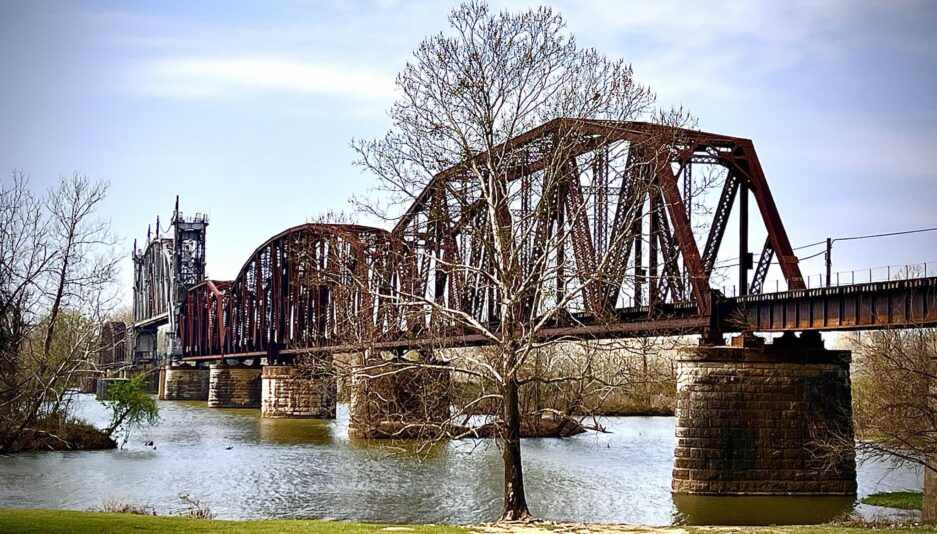
The Lovely Lady and I had taken a lovely drive along the mountaintops in southern Oklahoma and, realizing we were near an interesting old steel bridge, made a slight detour off the highway to get a photograph or two.  I assumed we would find a place to park on the near side of the structure and would walk over it, rather than driving.

The structure is, after all, nearly one hundred years old.  On the day it was completed in 1920, likely the only vehicles to cross it were a few horse drawn wagons and a Ford Model T or two.

The Model T weighed just over half a ton.

The comfy big pickup truck the Lovely Lady and I were driving tops out at just over two and a half tons.  I didn’t really want to test the bridge.

It was unsettling to drive up the approach to the old metal truss bridge and realize there was no place to park.  We reached the first span and I thought momentarily about backing the nearly three hundred feet to the closest turn off.

But, I’m a man.  Men don’t back up when they can go forward.

2016-07-03 14.22.45-2We went forward—over the rickety, rusty old bridge.  As we drove over it, the Lovely Lady read the results from the last inspection performed by the state.

“It says the substructure is rated only 2 out of 9 points—critical.  ‘Structurally deficient.’  Do you think we should be doing. . .”

Her voice trailed off, as we almost crawled across the river.

The steel and concrete span held our weight, but we held our breath until we were on solid ground again.

Almost a hundred years old, the man-made bridge has very nearly reached the end of its useful life.

Nearly done.

The thought of it makes me sad.

I’ve told you before how much I love bridges.  You may already know that the walls of our den hold nothing but paintings of the  wonderful structures.

In this room full of paintings depicting bridges, it is probably the least likely2016-07-16 00.23.27 piece of artwork to draw the eye.

I usually gravitate to the complicated designs, preferring to consider the concepts and scientific knowledge required to construct such strong, yet beautiful, framework.

This is not one of those.

The little bridge in the old watercolor is merely a solid piece of granite, hewn, not by human hands, but by the Creator Himself.  The form it retains today is largely the same form it had when it was laid over the muddy brown stream nearly five-hundred years ago.

It is a real bridge, still spanning the brook it crossed all those years ago.

A solid foundation lies under each end of the clapper stone bridge.  Two flat pieces of granite, possibly quarried from the same location as the arched bridge itself, have stood, unmoved, through five centuries.

The old structure has carried carts and foot traffic of all sorts—human and otherwise—safely across the brook.  In the spring floods, when the muddy brown water roared and whirled beneath it, safe passage was a guarantee.  Even when the flow of the brook is reduced to a trickle, the ancient piece of stone gives assurance of certain transit from one side of the little valley to the other.

But, like the much younger, fabricated bridge we crossed the other day, this bridge will one day (many years hence, one would hope) fail.  The flood may wash it off its foundation, or a crack may develop, the resulting fall of the stone into the brook bringing to an end its usefulness to mankind.

Again, the thought of it makes me sad.

All that man has established will, one day, come to nothing.

All of it.

There is one Bridge, though.  One Stone, laid by the hand of God Himself.

Eons ago, the words were spoken.  Today, they are still true:

Look!  I am laying a stone, firm and tested.  It is a priceless foundation that will never fail.  Whoever trusts it will never be disappointed.  (Isaiah 28:16)

A Bridge, laid across the gorge of destruction by the Creator—never to be removed—never to be inspected and declared structurally deficient.

It’s not complicated.  There are no angles.  No girders.  No need for advanced mathematics.

Just a plain Stone and an invitation to cross.

And, all we have to do is trust it to hold us.

Go ahead.  Take the first step.

You can hold your breath if you need to.

He will hold us.

Forever.


For I am convinced that neither death nor life, neither angels nor demons, neither the present nor the future, nor any powers, neither height nor depth, nor anything else in all creation, will be able to separate us from the love of God that is in Christ Jesus our Lord.
(Romans 8:38-39 ~ NIV)


The time worn granite clapper bridge
Spans the peat stained moorland brook,
The Dipper bobs as it hunts the midge
People cross with no second look.

Feet from ages long, long past
Have trod across the trusted stone,
The dawn and dusk have shadows cast
The sun has shone and cruel winds blown.

Men have come with brush in hand
To paint the scene through expert eye,
People followed to this desolate land
In search of something they know not why.

The rook as it sits in the solitary tree
Looks down on all that pass below,
He knows the secrets of you and me
And silently lets us cross the moorland flow.
(The Lonely Clapper ~ Anonymous)

© Paul Phillips. He’s Taken Leave. 2016. All Rights Reserved.

Never Much Hope

It was a hot Saturday afternoon in the Rio Grande Valley.  That, of course, could have described almost every one of the fifty-some Saturdays which occurred in any given year, but this one, I remember.

flag-football-1329752_640I remember it because it was the day the band geeks were going to show up the jocks in a game of two-below football.  I was one of the geeks.  Still am, truth be told.

You never saw such a group of unlikely athletes.  Oh, there were a few who had the physique for it, but the coordination hadn’t come along with the build.  On this day, we weren’t worried about that.

We were a team.  A group of guys focused on the same goal.  All for one and one for all.  We had heart.

The jocks showed up, jeering and making predictions.  Seventy to nothing, one big muscle-bound fellow taunted.  Others foresaw pain in our collective future.  

We weren’t afraid—much.

The game began.  For a little while, we held our own and it seemed that the predictions were very much flawed.  Then, little by little, our confidence faded.

Two-below football is a minimum contact form of the sport which allows blocking, but not much other hitting of body on body.  The person carrying the ball should expect nothing more than the slapping of two hands below the waist to bring the play to a halt.

Somehow, the jocks had the idea that it meant you simply tackled with two hands below the belt-line.  It turned out that one of the predictions had been right:  There was pain in our future.  A good bit of it.

I played for the entire first half.  A fair portion of the second half was spent on the ground along the sideline biting back the groans that a knee to the groin had elicited.  I was not alone on the sideline.  But still, I did get back out and play, however hampered I was by the discomfort, to end the game.

Heart or no heart, confidence or not, we lost—big time.  I don’t think the score was seventy to nothing, but it might as well have been.

There had never been a chance.  We were beaten before it began.

What’s that?

You thought the story would end better?  Perhaps a miracle finish?  Maybe a secret weapon to unleash upon the callous football players?

It didn’t happen.

It wasn’t a Hollywood story, you know.  It wasn’t even an epic fairy tale.

Happily ever after didn’t happen.

We lost.  Utterly and completely.

That’s life.  No, really.  It’s what life is.  Reality isn’t all parties and happiness.  Nobody wins every time.  Nobody.

Some of my friends will be unhappy with me as they read this.  Many voices have spoken different words into their lives.

I will respectfully and (hopefully) gently insist that our Creator has a different path for us.

For the last few years, the muttering has been growing.  Folks are unhappy with the thought that many good things are coming to an end.  We expected, as followers of Jesus, to live peacefully and unharmed in a bounty-filled land.

Wealth and plenty have been ours.  Our voices have been the only ones we heard, as we have grown fat and selfish.

Perhaps, I should speak for myself.  I have heard my own voice as I spoke words I believed to be true.  Speaking and not acting, I have grown fat.  In the absence of opposition, I have grown selfish beyond belief.

And now, in a way my grandparents and my parents never experienced, the world just outside my front door has grown increasingly unfriendly to my comfort and ease.

Don’t get me wrong.  I’m not claiming persecution.  I’ve seen—from afar—what happens to believers when they are persecuted.  I haven’t experienced even a fraction of that, nor have most folks I’m acquainted with.

But, it may come to that.  Being neither a prophet nor the son of a prophet, I cannot say.

Still, we are promised, not comfort, but discomfort.  We are promised, not open arms from the world around us, but reproach.  Folks we call our neighbors will turn on us.

I’m not talking about end-times prophecy.  I’m simply averring that this is what life will be for us if we truly follow Jesus.  

After all, He is the One who promised hardship.  Promised it.  (John 16:33)

He never asked us to win the battle for men’s hearts for Him.  That’s His job.  He simply asked us to stand firm to the end.

He never suggested that we would be happy and trouble-free because we serve Him faithfully, but He did promise that we will inherit His kingdom.  (Matthew 5:10)  

And, that brings us to the one other thing He did promise:  The day is coming.

The day is coming when all of this will fade into nothingness.  All the pain.  All the sadness.  All the jeering.  All the hardships we’ve ever faced.

All of it.  Nothing.  Nothing at all.

The Apostle Paul wrote down the words he was given by the Spirit:  

There is no comparison in any way between the passing inconveniences of this world and the unbelievable glory which will be ours in the next.  (Romans 8:18)

There are days when I am overcome with weariness—with sorrow—with despair.  This mountain I am facing can never be scaled, can never be conquered.

A friend reminded me tonight of that great fortress called Doubting Castle, kept by the Giant Despair.  John Bunyan wrote of it hundreds of years past.  

Many I know have been held captive there.  Many I know are still chained in its dungeon.

Still, it’s as true today as it was in the days when Mr. Bunyan sat in prison for his faith—still as true as in the early days of the Church:  The world has been overcome by the One we follow.  The outcome has never been in doubt.

Our day is coming.  

Hope’s spark still burns deep within each one who follows Him.

Our enemy doesn’t play by the rules.  He never has.  He seems so much more powerful than we are.  That hasn’t changed, either.

We seem so easily injured and tired out.

But, the game is not over yet.

And, he has been fooled before.

And, defeated.

As it turns out, he’s the one who never had any hope of winning.

I’m going to stick it out.

You?


And if our hope in Christ is only for this life, we are more to be pitied than anyone in the world.  
(1 Corinthians 15:19 ~ NLT)


“I wish it need not have happened in my time,” said Frodo.
“So do I,” said Gandalf, “and so do all who live to see such times, But that is not for them to decide.  All we have to decide is what to do with the time that is given us.”
(from The Two Towers ~ J.R.R. Tolkien ~ English novelist ~ 1892-1973)


© Paul Phillips. He’s Taken Leave. 2016. All Rights Reserved.